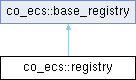
Registry is a container for all our entities and components. Components are stored in continuously in memory allowing for very fast iterations, a so called SoA approach. A set of unique components form an archetype, where every entity is mapped to an archetype. More...
#include <registry.hpp>
Public Member Functions | |
| template<component... Components> | |
| constexpr auto | create (Components &&... args) -> entity_ref |
| Creates a new entity and attaches the specified components to it. | |
| constexpr auto | get_entity (entity ent) noexcept -> entity_ref |
| Retrieves a mutable reference to an entity. | |
| constexpr auto | get_entity (entity ent) const noexcept -> const_entity_ref |
| Retrieves a constant reference to an entity. | |
| constexpr auto | get_entity_const (entity ent) const noexcept -> const_entity_ref |
| Retrieves a constant reference to an entity (alias). | |
| template<component_reference... Args> | |
| constexpr auto | view () -> co_ecs::view< Args... > requires(!const_component_references_v< Args... >) |
| Create a non-const view based on component query in parameter pack. | |
| template<component_reference... Args> requires const_component_references_v<Args...> | |
| constexpr auto | view () const -> co_ecs::view< Args... > |
| Create a const view based on component query in parameter pack. | |
| template<component_reference... Args> | |
| constexpr auto | single () -> std::optional< std::tuple< Args... > > requires(!const_component_references_v< Args... >) |
| Returns a single tuple of components matching Args, if available in the view. | |
| template<component_reference... Args> requires const_component_references_v<Args...> | |
| constexpr auto | single () const -> std::optional< std::tuple< Args... > > |
| Returns a single tuple of components matching Args, if available in the view. | |
| template<typename F > requires (!detail::func_decomposer<F>::is_const) | |
| constexpr void | each (F &&func) |
| Executes a given function on each entity that matches the specified component requirements. | |
| template<typename F > requires (detail::func_decomposer<F>::is_const) | |
| constexpr void | each (F &&func) const |
| Executes a given function on each entity that matches the specified component requirements, without modifying the entities. | |
| constexpr std::size_t | size () const noexcept |
| Returns the number of enitites in the registry. | |
| constexpr bool | empty () const noexcept |
| Checks if the registry currently manages any entities. | |
 Public Member Functions inherited from co_ecs::base_registry Public Member Functions inherited from co_ecs::base_registry | |
| constexpr auto | alive (entity ent) const noexcept -> bool |
| Checks if the specified entity is currently active within the registry. | |
| void | destroy (entity ent) |
| Destroys the given entity. | |
| constexpr auto | archetypes () noexcept -> class archetypes & |
| Provides access to the modifiable list of archetypes in the registry. | |
| constexpr auto | archetypes () const noexcept -> const class archetypes & |
| Provides access to the immutable list of archetypes in the registry. | |
| constexpr auto | reserve () -> placeholder_entity |
| Reserves an entity in a thread-safe manner. | |
| constexpr void | sync () |
| Synchronizes concurently reserved entities. | |
| template<component... C> | |
| constexpr auto | has (entity ent) const -> bool |
| Checks if the specified entity has all the given components. | |
| constexpr void | visit (entity ent, auto &&func) |
| Visit all components of an entity. | |
| constexpr void | visit (entity ent, auto &&func) const |
| Visit all components of an entity (const variant). | |
Additional Inherited Members | |
| Protected Member Functions inherited from co_ecs::base_registry | |
| template<component... Components> | |
| constexpr auto | create_impl (Components &&... args) -> entity |
| template<component C> | |
| constexpr auto | set_impl (entity ent) -> std::pair< bool, C * > |
| template<component C> | |
| constexpr void | remove (entity ent) |
| constexpr auto | allocate () -> entity |
| entity | move (entity ent, base_registry &dest) |
| entity | copy (entity ent, base_registry &dest) const |
| entity | move (entity ent, base_registry &dest, placeholder_entity placeholder) |
| entity | copy (entity ent, base_registry &dest, placeholder_entity placeholder) const |
| entity | clone (entity ent) |
| entity | clone (entity ent, placeholder_entity placeholder) |
| Static Protected Member Functions inherited from co_ecs::base_registry | |
| template<component... Args> | |
| static constexpr auto | get_impl (auto &&self, entity ent) -> decltype(auto) |
| Protected Attributes inherited from co_ecs::base_registry | |
| entity_pool | _entity_pool |
| class archetypes | _archetypes |
| detail::sparse_map< typename entity::id_t, entity_location > | _entity_archetype_map |
Detailed Description
Registry is a container for all our entities and components. Components are stored in continuously in memory allowing for very fast iterations, a so called SoA approach. A set of unique components form an archetype, where every entity is mapped to an archetype.
Member Function Documentation
◆ create()
|
inlineconstexpr |
Creates a new entity and attaches the specified components to it.
This method instantiates a new entity and assigns it the components provided as template arguments. It ensures all component types are unique, sets the components to the entity, and returns a reference to the newly created entity.
Example usage:
- Template Parameters
-
Component Component types to attach to the new entity.
- Parameters
-
args Instances of components to attach.
- Returns
- entity_ref A reference to the newly created entity, allowing further operations.
◆ each() [1/2]
requires (!detail::func_decomposer<F>::is_const)
|
inlineconstexpr |
Executes a given function on each entity that matches the specified component requirements.
This method iterates over each entity that has the required components and applies the function func.
- Template Parameters
-
F The type of the callable function to run on the entity components.
- Parameters
-
func A callable to run on entity components.
Example
◆ each() [2/2]
requires (detail::func_decomposer<F>::is_const)
|
inlineconstexpr |
Executes a given function on each entity that matches the specified component requirements, without modifying the entities.
This constant version of each allows for iteration over entities in a read-only fashion. It is suitable for operations that only need to read component data without modifying it, ensuring that the entity data remains unchanged. This method shares the same optimization benefits as its non-constant counterpart.
- Template Parameters
-
F The type of the callable function to run on the entity components.
- Parameters
-
func A callable to run on entity components, must not modify the entities.
◆ empty()
|
inlineconstexprnoexcept |
Checks if the registry currently manages any entities.
- Returns
- bool Returns true if the registry has no entities, false otherwise.
◆ get_entity() [1/2]
|
inlineconstexprnoexcept |
Retrieves a constant reference to an entity.
This method returns a constant reference to the specified entity from the registry.
- Parameters
-
ent The entity to retrieve.
- Returns
- A constant reference to the specified entity.
- Note
- This method is marked as
[[nodiscard]]andconstexpr.
◆ get_entity() [2/2]
|
inlineconstexprnoexcept |
Retrieves a mutable reference to an entity.
This method returns a mutable reference to the specified entity from the registry.
- Parameters
-
ent The entity to retrieve.
- Returns
- A mutable reference to the specified entity.
- Note
- This method is marked as
[[nodiscard]]andconstexpr.
◆ get_entity_const()
|
inlineconstexprnoexcept |
Retrieves a constant reference to an entity (alias).
This method is an alias for get_entity to return a constant reference to the specified entity from the registry.
- Parameters
-
ent The entity to retrieve.
- Returns
- A constant reference to the specified entity.
- Note
- This method is marked as
[[nodiscard]]andconstexpr.
◆ single() [1/2]
|
inlineconstexpr |
Returns a single tuple of components matching Args, if available in the view.
- Returns
- Optional tuple of components if found, otherwise empty optional
◆ single() [2/2]
requires const_component_references_v<Args...>
|
inlineconstexpr |
Returns a single tuple of components matching Args, if available in the view.
This method is available in const registry and allows accessing a single tuple of components matching Args. It returns an optional tuple, which is empty if no entities in the view match the component requirements.
- Returns
- Optional tuple of components if found, otherwise empty optional
◆ size()
|
inlineconstexprnoexcept |
Returns the number of enitites in the registry.
- Returns
- Number of entities present in the registry
◆ view() [1/2]
|
inlineconstexpr |
Create a non-const view based on component query in parameter pack.
- Template Parameters
-
Args Component references
- Returns
- view<Args...> A view
◆ view() [2/2]
requires const_component_references_v<Args...>
|
inlineconstexpr |
Create a const view based on component query in parameter pack.
- Template Parameters
-
Args Component references
- Returns
- view<Args...> A view
The documentation for this class was generated from the following file:
- include/co_ecs/registry.hpp